As cyberattacks become more sophisticated, organizations are increasingly investing in immutable backups, ransomware protection, and cyber recovery capabilities. While these technologies are essential, many recovery discussions still focus primarily on backup data itself.
In reality, successful cyber recovery is about much more than restoring data. It is about restoring trust, validating workloads, and ensuring business operations can continue while production environments are being rebuilt.
This is where Clean Rooms and Recovery Zones play a critical role.
The Problem with Traditional Recovery
Historically, disaster recovery focused on one objective: restoring systems back into production as quickly as possible.
Cyber incidents have fundamentally changed that approach.
Modern attackers often spend weeks inside an environment before launching ransomware. During that time, compromised accounts, malware, unauthorized tools, or malicious configurations may already exist within systems that appear healthy.
As a result, organizations must answer two critical questions:
- Can we trust the workloads we are recovering?
- Where will critical business services operate while production is being rebuilt?
- The answer to the first question is the Clean Room.
- The answer to the second is the Recovery Zone.
A Real-World Scenario
Imagine a ransomware attack impacting your core infrastructure.
You restore your systems from backup — but unknowingly, those backups contain:
- compromised service accounts
- persistence mechanisms
- hidden attacker tools
If you restore directly into production, the attacker may regain access within hours.
At the same time, your business cannot afford days (or weeks) of downtime while environments are rebuilt.
This is exactly where Clean Rooms and Recovery Zones become essential.
What Is a Clean Room?
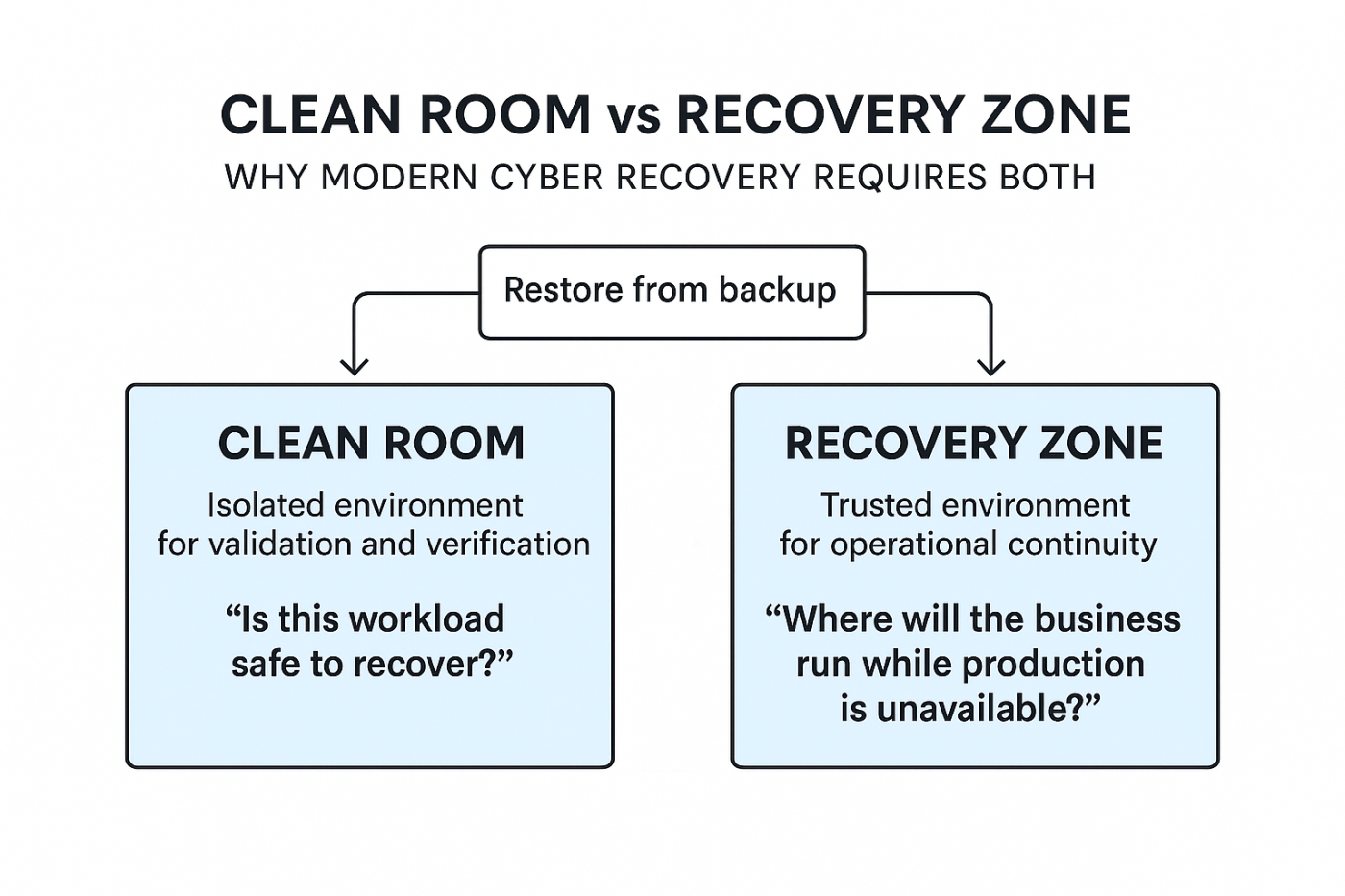
A Clean Room is an isolated, controlled environment used to safely restore and validate workloads before they are reintroduced into production or recovery operations.
Its primary purpose is verification and trust validation.
Within a Clean Room, organizations can:
- Restore virtual machines and applications
- Perform malware scanning and threat analysis
- Validate application functionality
- Investigate indicators of compromise (IoCs)
- Confirm that recovery points are safe to use
Clean Rooms are often designed as repeatable, controlled processes, not just one-off environments.
The goal is not to permanently run business services there, but to ensure recovered workloads are clean and trustworthy.
Simply put:
👉 A Clean Room answers the question: “Is this workload safe to recover?”
What Is a Recovery Zone?
A Recovery Zone serves a different purpose.
Rather than validating workloads, a Recovery Zone provides a trusted operational environment where cleaned and validated workloads can run during a cyber incident.
After validation in the Clean Room, critical applications are restored into the Recovery Zone and made available to users while the primary production environment is:
- investigated
- remediated
- rebuilt
A properly designed Recovery Zone typically includes:
- Dedicated compute resources
- Isolated networking
- Independent security controls
- Strict access management policies
- Controlled connectivity for critical services
Importantly, a Recovery Zone may operate in a degraded or scaled-down mode, focusing on the most critical business functions rather than full production capacity.
In many organizations, the Recovery Zone effectively becomes the temporary production environment until primary systems can be safely restored.
Simply put:
👉 A Recovery Zone answers the question: “Where will the business run while production is unavailable?”
Why Both Environments Matter
One of the most common misconceptions is treating Clean Rooms and Recovery Zones as interchangeable.
They are not.
- A Clean Room establishes trust
- A Recovery Zone ensures continuity
Without a Clean Room:
- You risk restoring compromised workloads
Without a Recovery Zone:
- You may have trusted workloads, but nowhere safe to run them
Together, they:
- reduce recovery risk
- shorten decision time
- improve operational resilience during incidents
Recovery Is More Than Restore
Cyber resilience is often measured by backup success rates, recovery times, and storage immutability.
While these remain important, they do not fully address real-world cyber incidents.
The most resilient organizations understand that recovery is not just a restore operation.
It is a structured process of:
- validating trust
- restoring critical services
- maintaining business continuity under adverse conditions
Backups provide the foundation.
Clean Rooms establish trust.
Recovery Zones keep the business running.
Final Thought
How is your organization approaching Clean Rooms and Recovery Zones?
- Are they part of your cyber recovery strategy?
- Are your recovery plans still focused solely on restoring data back into production?


Leave a Reply