
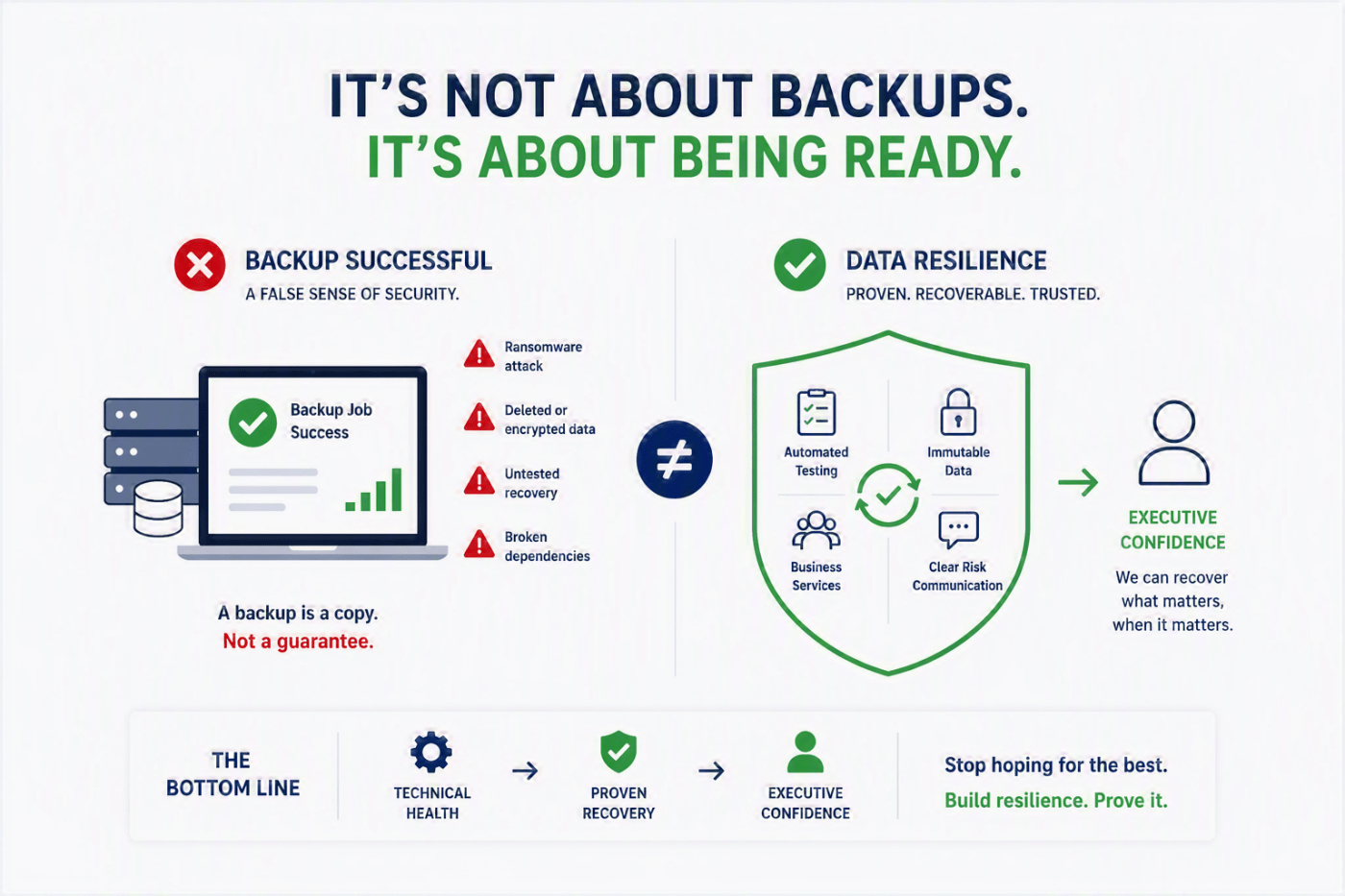
If you walk into any IT department and look at the monitoring screens, you will likely see dashboards filled with “Job Successful” notifications. In the world of data protection, a console showing a 100% success rate is deeply satisfying. It helps infrastructure engineers sleep at night.
But in today’s landscape of sophisticated ransomware attacks and stringent compliance regulations (like DORA or NIS2), relying solely on those success notifications can be the most dangerous trap in your infrastructure. They create a powerful, yet fragile, illusion of safety.
Here is the uncomfortable truth: Technical health does not equal business resilience.
The Gap Between “Backed Up” and “Recoverable”
For years, the IT industry has focused heavily on the backup process itself. Did the job run? Did it finish within the backup window? Was the data successfully copied to the repository?
While a healthy backup environment is the foundational requirement, we must separate basic data protection from proven recoverability. The reality is that a backup job can succeed while application dependencies, credentials, network configuration, or recovery documentation are still completely broken or incomplete.
If a ransomware attack strikes, having a secure copy of your database is useless if the underlying network routing is destroyed and the active directory credentials needed to spin up the recovery environment are unavailable. You have a restore point, but you do not have a proven business service.
Shifting Focus: From Technical Features to Business Outcomes
To build true resilience, infrastructure professionals need to shift their mindset. The successful outcome isn’t simply that backup jobs are green. The successful outcome is that the customers critical services are protected, recoverable, and able to meet the recovery expectations agreed with the business.
This is where the concept of Data Resilience comes in. Resilience requires us to translate a technical feature into an operational change, and ultimately, into a business outcome.
When a CIO or CISO asks the fundamental question: Are we protected?, answering with a simple yes based solely on successful backup jobs is no longer responsible. If the most important business services have not completed a full, end-to-end recovery validation, the honest answer is: We are protected, but not fully proven.
How to Build True Executive Confidence
So, how do we bridge the gap between technical operations and executive confidence?
- Automated Recovery Testing: We must stop assuming that a completed backup job equals a successful restore. Until you actually validate the recovery process, a backup is just a meaningless file sitting on a repository. Regular, automated testing in isolated environments provides concrete evidence that a complete service can recover.
- Focus on Business Services, Not Just VMs: Disaster recovery should be mapped to critical business functions. A resilience score means very little if the untested 15% of your environment happens to be your core banking application or main CRM.
- Data Immutability as a Standard: In the age of ransomware, having a backup is not enough if the attacker can encrypt or delete the backup repository itself. Immutable storage must be a non-negotiable layer of your architecture.
- Transparent Risk Communication: Executives do not need a long technical history of how a backup failed; they need clarity on business impact, ownership, and the next decisions required to mitigate the risk.
The Bottom Line
The next time you review your data protection strategy, look past the green checkmarks. Challenge your team and your architecture.
Stop asking: Are our backups successful? Start asking: When was the last time we proved we could recover our three most critical business services within our agreed RTO?
The ultimate goal of any infrastructure investment should follow a clear, undeniable path: Technical health ➔ Proven recovery ➔ Executive confidence. Anything less is just hoping for the best. And hope is not a valid Disaster Recovery strategy.


Leave a Reply