
Cybersecurity has traditionally focused on one fundamental objective: preventing attackers from getting in. Firewalls, endpoint protection, identity controls and threat detection remain essential, but modern cyber resilience starts from a different assumption: what happens when prevention fails?
This shift is particularly important in the age of ransomware and AI-driven attacks. Cyber incidents can spread across systems, identities and data at machine speed. As a result, organizations need more than the ability to detect an attack. They need to understand its impact, protect their recovery infrastructure and restore business operations quickly and safely.
This is where artificial intelligence is beginning to transform backup and recovery.
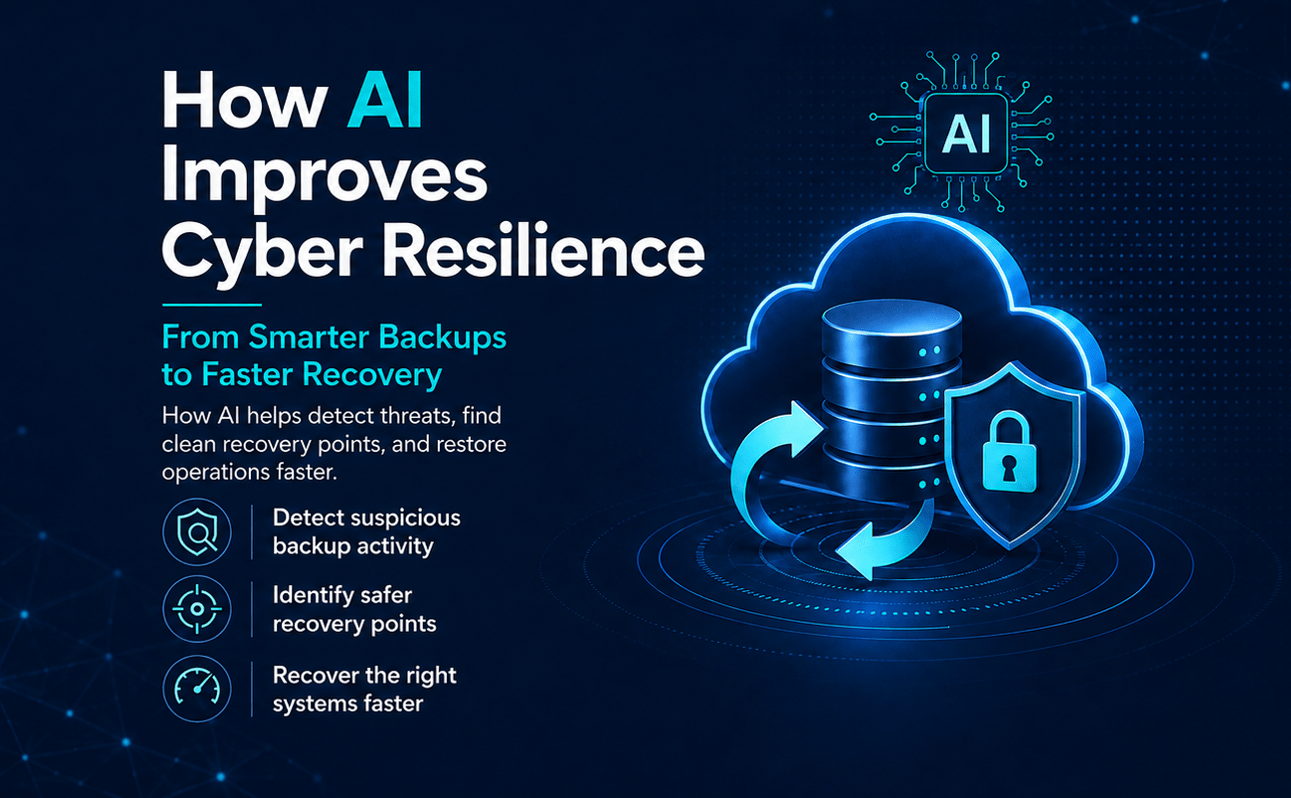
Backup used to be a relatively passive process: copy the data, store it somewhere safe and restore it when necessary. Today, leading cyber resilience platforms are turning backup environments into intelligent security systems. AI and machine learning can analyze changes in protected data, detect suspicious behavior, identify potentially clean recovery points and help organizations make better recovery decisions.
The result is a fundamental change in the role of backup: from an insurance policy to an active component of cyber defense.
Backups Are Becoming a Source of Security Intelligence
Every backup contains more than just files and applications. It also contains information about how an environment changes over time.
Under normal circumstances, those changes tend to follow recognizable patterns. Employees create and modify files, databases grow gradually and applications generate relatively predictable volumes of data.
A ransomware attack looks very different.
Thousands of files may suddenly change within minutes. Encryption can significantly alter file characteristics. Large numbers of objects may be renamed, deleted or modified. New files associated with ransomware activity may appear across multiple systems.
Machine-learning models can analyze these patterns and identify deviations from normal behavior. Some modern platforms perform this analysis directly during the backup process, looking for indicators such as abnormal file modifications, encryption behavior, suspicious file-system activity and known malware artefacts.
This creates an additional detection layer that is independent of the production environment.
That independence is important. If an attacker compromises endpoints or security tools, backup infrastructure can provide another perspective on what happened. Historical backup data can help security teams understand when suspicious activity started and how far it spread.
In other words, the backup repository becomes a valuable source of forensic information.
Finding the Right Recovery Point
Having a backup is only the beginning of ransomware recovery.
The much harder question is:
Which backup should we restore?
Restoring the latest available copy may seem logical, but that copy could already contain malware or attacker persistence mechanisms. Restoring an infected system can simply restart the incident.
Traditionally, identifying a clean recovery point could require significant manual investigation. Security and infrastructure teams might need to compare timestamps, analyze logs, inspect multiple snapshots and estimate when the compromise started.
AI can significantly accelerate this process.
By combining historical backup information with anomaly detection, malware scanning and security telemetry, modern resilience platforms can help estimate the scope and timeline of an attack. Suspicious recovery points can be isolated while potentially clean versions are prioritized for validation.
Instead of asking engineers to search manually through dozens or hundreds of restore points, the system can narrow the investigation to the most relevant candidates.
This can reduce one of the biggest sources of uncertainty during cyber recovery.
From Full Restore to Surgical Recovery
AI also changes what organizations restore.
Traditional disaster recovery often assumes a relatively broad recovery operation. A server fails, so the server is restored. A large environment is compromised, so large parts of that environment may be rolled back.
Cyberattacks are rarely that simple.
Some systems may remain healthy. Only specific mailboxes, files, virtual machines or application objects may have been affected. Restoring everything could create unnecessary downtime or remove legitimate changes made after the incident began.
This is leading to the concept of surgical recovery.
By understanding what changed, which objects were affected and where suspicious activity occurred, AI-assisted resilience platforms can help organizations restore only what is necessary. Current approaches are increasingly combining information about data, user identities, permissions and AI-agent activity to provide this context.
The difference is significant.
Recovery becomes less about restoring infrastructure and more about restoring business operations with minimal disruption.
Recovering Clean, Not Just Fast
Speed is critical during a cyberattack, but restoring quickly is dangerous if the organization cannot trust the data being recovered.
This is why clean-room recovery is becoming an important part of modern cyber resilience.
A clean room is an isolated environment where systems and data can be restored without immediately reconnecting them to production. Once restored, they can be scanned, analyzed and validated before being allowed back into the operational environment.
AI and automation can make this process considerably more efficient.
Modern platforms can combine machine-learning detection with malware signatures, behavioral analysis and technologies such as YARA rules to inspect recovery data. Automated workflows can also verify whether workloads boot correctly, whether applications respond as expected and whether predefined recovery tests succeed.
This transforms recovery from a simple technical action:
Restore the backup.
into a controlled process:
Restore, isolate, inspect, validate and then return to production.
The distinction matters because successful cyber recovery is not measured by whether a restore job completed. It is measured by whether the organization returned to a trustworthy operational state.
AI Can Help Decide What Comes Back First
Another challenge appears when hundreds or thousands of systems need to be restored.
Which one should be first?
The answer is not necessarily the largest database or most powerful server. The priority should be determined by business dependencies.
An organization may need identity services before employees can log in. Those employees may then need communication and collaboration platforms. Critical applications may depend on databases, networking services and specific identity configurations.
Recovering these components in the wrong order can delay the entire process.
AI can help map relationships between applications, data, users and identities and use that information to support recovery sequencing. Some current resilience strategies go even further by defining a minimum viable business: the smallest combination of people, identities, applications and data required to resume critical operations.
Rather than restoring everything simultaneously, organizations can priorities what is required to get the business functioning again.
That is a much more meaningful measure of resilience.
From Recovery Scripts to Agentic Recovery
Perhaps the most interesting development is the emergence of agentic AI.
Traditional automation follows predefined instructions. If condition A occurs, perform action B.
Agentic systems can go further. They can analyse multiple sources of information, reason about a problem, propose a sequence of actions and coordinate a multi-step recovery workflow.
Imagine a ransomware incident affecting collaboration services, identities and thousands of user files.
Instead of an administrator manually checking multiple consoles, an AI agent could analyze recent activity, identify affected objects, determine likely clean recovery points, establish the recovery sequence and present a proposed recovery plan.
After human approval, it could orchestrate the required actions and continuously validate the results. Current implementations are already moving towards this model while maintaining approval mechanisms, auditability and reversible actions.
This is important because cyber recovery is usually not one action.
It is a sequence of dependent decisions.
AI is particularly valuable when it can connect those decisions.
Generative AI Can Reduce Operational Complexity
Not every application of AI in cyber resilience needs to be fully autonomous.
Generative AI can also make backup environments easier to operate.
Administrators increasingly need to manage complex hybrid environments covering cloud services, SaaS platforms, virtual machines, databases and traditional infrastructure. Finding the right information during an incident can require knowledge of multiple interfaces and hundreds of configuration options.
A natural-language interface can simplify this.
Instead of navigating through dashboards, an administrator could ask:
Which backup jobs failed during the last 24 hours?
Which protected systems show unusual changes?
Do we have a clean recovery point for this application?
Which workloads currently fail our recovery policy?
AI assistants can combine product documentation with live operational information such as backup status, alarms and malware-detection events to provide contextual answers.
This may sound less revolutionary than autonomous recovery, but during a high-pressure incident, reducing the time required to find information can be extremely valuable.
AI Also Creates a New Recovery Problem
There is another side to this transformation.
AI is not only helping organizations recover from incidents. AI systems themselves are becoming something organizations may need to recover from.
Enterprise AI agents can increasingly modify documents, interact with applications, access sensitive information and execute actions across business systems.
An incorrectly configured or over-privileged agent could therefore modify or delete thousands of objects very quickly. A malicious prompt could potentially trigger actions that were technically authorized but operationally destructive.
This introduces a new resilience requirement: organizations need visibility into what AI agents are doing and the ability to reverse unwanted changes.
Modern resilience architectures are consequently beginning to combine data protection with AI governance. They track relationships between agents, identities and data and introduce mechanisms for investigating or rolling back unwanted agent-driven activity.
In this context, backup becomes something surprisingly relevant to the AI era:
an enterprise-scale undo button.
AI Does Not Replace Good Backup Architecture
Despite these capabilities, AI should not be treated as a substitute for traditional resilience fundamentals.
A sophisticated algorithm cannot recover data that no longer exists.
Organizations still need isolated and immutable backup copies, appropriate access controls, encryption, network segmentation and clearly defined RPO and RTO requirements. Recovery procedures still need to be documented and tested regularly. Current enterprise platforms continue to treat immutability, isolation and automated recovery testing as foundational controls rather than features that AI can replace.
Human oversight also remains important.
AI may identify an anomaly that is actually a legitimate business event. It may recommend the wrong recovery point or misunderstand the business importance of a particular application. Fully autonomous recovery without appropriate guardrails could therefore introduce additional risk.
The strongest model is likely to be a combination of machine-speed analysis and automation with human-controlled decision points.
AI does the investigation and heavy operational work.
Humans remain responsible for the critical decisions.
Cyber Resilience Is Becoming Intelligent
The biggest impact of AI on backup is not simply that backups will become faster.
It is that recovery is becoming more intelligent.
AI can help detect abnormal activity while backups are being created, determine the potential blast radius of an attack, identify safer recovery points, validate data in isolated environments and priorities the systems required to restore business operations.
Generative AI can make complex resilience platforms easier to operate, while agentic AI can increasingly coordinate recovery workflows that previously required multiple teams and many manual steps.
This represents an important evolution in cyber resilience.
The traditional question was:
Do we have a backup?
The next question became:
Can we restore it?
In the age of ransomware and AI-driven threats, organizations need to ask something more demanding:
Can we understand what happened, identify what is safe, and recover the right parts of the business quickly enough to keep operating?
Artificial intelligence is increasingly helping organizations answer that question.
And that may ultimately be its most important contribution to cyber resilience.
 vmcloud.pl
Leave a comment