
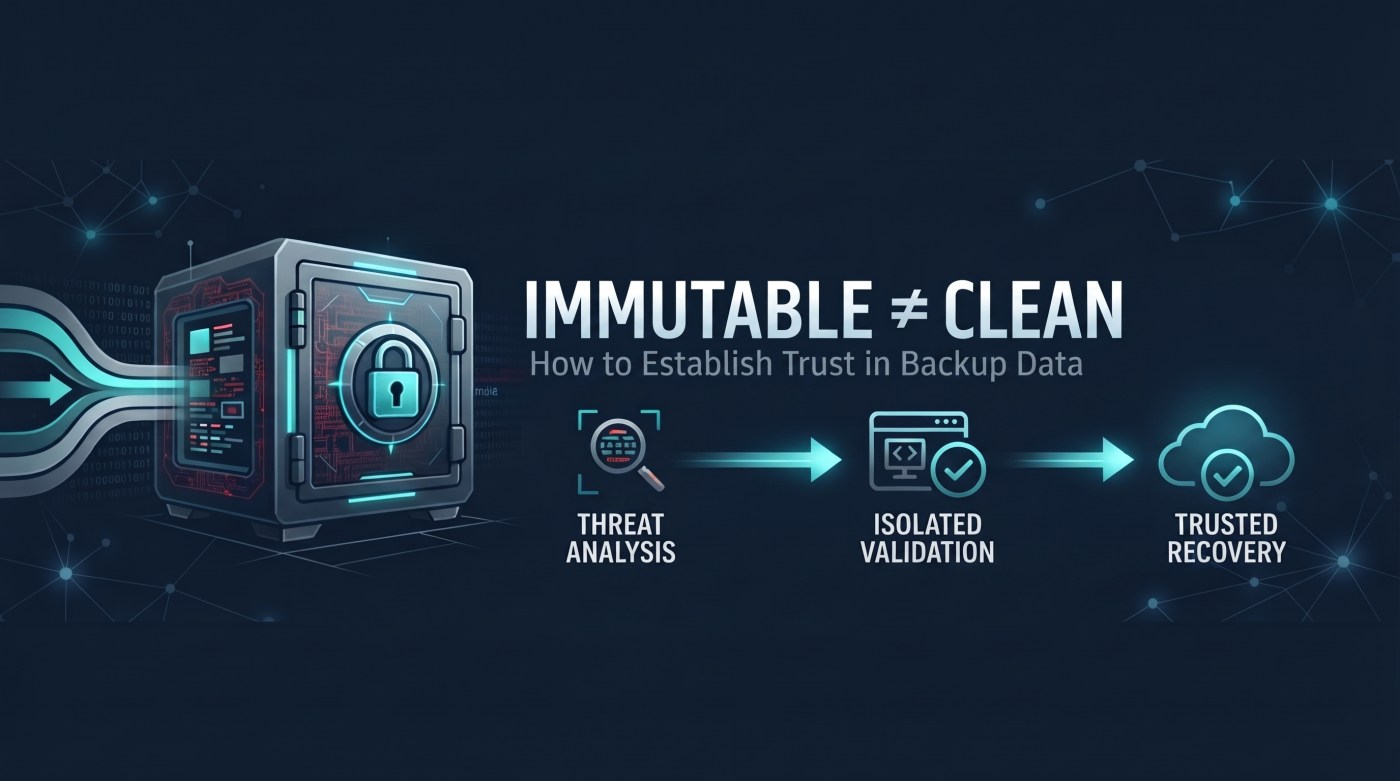
Your backup completed successfully. The recovery point is immutable, and all integrity checks passed. Everything looks good from a backup perspective. But does that actually mean the data is safe to restore?
For years, backup strategies have focused on protecting data against loss, corruption, and accidental deletion. More recently, immutability has become an essential part of ransomware protection, helping organizations prevent attackers from modifying or deleting backup copies. However, there is an important distinction that is sometimes overlooked: protecting a backup from modification does not guarantee that the data inside it is trustworthy.
An immutable backup can preserve compromised files, malicious configurations, or persistence mechanisms just as effectively as it preserves legitimate business data. This raises an important question for organizations preparing their cyber recovery strategies: what actually makes a backup clean, and how can we establish enough confidence to use it for recovery?
Immutability Protects the Copy, Not Its Contents
Let’s start with what immutability actually provides. When a backup is immutable, it is protected against modification or deletion during its defined retention period, assuming the underlying protection mechanisms remain effective. This is a critical security control, particularly when attackers attempt to destroy recovery options before launching ransomware. However, immutability and the security state of the protected workload are two different aspects of data protection.
Consider a server that has already been compromised. An attacker may have installed a malicious service, modified scheduled tasks, created unauthorized accounts, or changed system configurations. If a backup runs at that moment, it may capture those changes. Once stored in immutable storage, that backup becomes protected against modification, but it also preserves the compromised state.
From the backup system’s perspective, everything may look perfectly normal. The backup completed successfully, the data is consistent, and its integrity can be verified. Yet restoring that system without additional security validation could reintroduce the same weaknesses or persistence mechanisms that contributed to the original incident.
This is why I believe immutability should be viewed as a foundation of cyber resilience rather than proof that a recovery point is clean. An intact backup is not necessarily a safe backup, which makes additional threat analysis and recovery validation essential parts of a modern cyber recovery strategy.
The Real Challenge: When Did the Compromise Begin?
One of the biggest challenges during ransomware recovery is determining when the attacker first gained access to the environment. Encryption is often the most visible stage of an attack, but it does not necessarily mark the beginning of the compromise. Depending on the attack, malicious activity may have started days or even weeks earlier.
Imagine a scenario where an attacker gains access to an organization’s environment using compromised credentials. Over the following days, the attacker explores the network, escalates privileges, and establishes persistence. On Day 12, a scheduled task is modified to execute malicious code. On Day 20, ransomware encryption begins, causing a major operational disruption.
The organization has daily immutable backups, including a successful backup from Day 19. From a traditional backup perspective, restoring the latest available recovery point seems like the logical choice. It minimizes data loss and helps meet the Recovery Point Objective (RPO). However, from a security perspective, that backup may already contain malicious changes introduced several days earlier.
This is where historical analysis becomes particularly valuable. By correlating backup recovery points with security events and incident investigation findings, recovery teams can identify suspicious changes, narrow down the potential compromise window, and evaluate which recovery points provide the best foundation for restoration.
For example, comparing recovery points before and after the malicious scheduled task was introduced could help identify when specific changes appeared. Combined with information about the attacker’s initial access and subsequent activity, this provides useful context for selecting and validating recovery data.
The latest recovery point is not always the safest one, and selecting an older copy should be based on evidence rather than assumptions. Different systems may have been affected at different stages of an attack, while older recovery points may involve additional operational considerations, such as data loss or outdated configurations.
Finding a trustworthy recovery point therefore requires more than simply going backwards through the backup timeline. It involves combining backup history, threat intelligence, and incident investigation results to make an informed recovery decision.
What Does a Clean Backup Actually Mean?
Traditionally, backup validation has focused on whether a backup is complete, consistent, readable, and recoverable. These checks remain essential, but modern cyber recovery introduces additional security considerations. In my view, establishing trust in backup data requires evaluating five complementary areas.
1. Data Integrity
The first step is verifying that the backup has remained intact since it was created. Cryptographic integrity checks and backup consistency verification help identify corruption or unexpected modifications and confirm the reliability of the stored recovery data.
Combined with threat analysis and security validation, these controls provide a stronger foundation for assessing the trustworthiness of a recovery point.
2. Threat Exposure
The next step is analyzing the recovery point for potential security threats. Depending on the available capabilities, this may involve malware scanning, file reputation analysis, searching for indicators of compromise (IoCs), or examining configurations associated with attacker persistence.
Threat analysis helps security teams identify suspicious content and assess the security state of backup data before restoration. When combined with other sources of security intelligence, it becomes an important part of selecting appropriate recovery points.
3. Historical Context
A recovery point becomes much more meaningful when we understand what was happening in the environment at the time it was created. Correlating backup history with security alerts, endpoint telemetry, identity events, and incident investigation findings helps identify potentially compromised recovery points.
For example, if an investigation identifies when a malicious configuration change was introduced, backup history can help determine which recovery points were created before and after that event. This information helps recovery teams evaluate available copies and make more informed decisions.
4. Recoverability
Beyond assessing the security state of backup data, we also need to confirm that workloads can be restored and function as expected. Regular recovery testing helps validate application consistency, system dependencies, and the overall recovery process.
Testing the restored workload provides practical evidence that applications and services can be brought back online within the organization’s recovery requirements. This connects backup reliability with actual operational readiness.
5. Operational Trust
Finally, we need to establish confidence that the recovered workload can safely return to production. This includes validating security configurations, reviewing privileged access, addressing the original attack path, and confirming that the restored environment meets the organization’s security requirements.
These five areas work together to provide a more complete view of recovery readiness. By combining data integrity, threat analysis, historical context, recovery testing, and operational validation, organizations can establish a stronger basis for trusted recovery.
From Backup Scanning to Backup Threat Hunting
One of the more interesting developments in cyber recovery is the growing role of backup data in security investigations. Backup copies represent historical states of an organization’s systems and information. Depending on the workload and backup method, they may contain files, configurations, application data, and other artifacts captured at different points in time.
This historical information can be extremely useful during incident response. Instead of treating backups only as copies waiting to be restored, we can also use them as an additional source of security evidence.
For example, comparing recovery points may help identify when suspicious files appeared, when system configurations changed, or when unusual patterns of data modification started. Security teams can search supported backup content for known indicators of compromise and correlate their findings with information from endpoint detection and response (EDR), security information and event management (SIEM), and identity security systems.
Anomaly detection provides another useful perspective. Unexpected file modifications, unusual deletion activity, or sudden changes in data characteristics can highlight patterns that deserve further investigation. Machine learning techniques can help identify these patterns at scale, particularly in large environments where manually analyzing every recovery point would be impractical.
The effectiveness of backup threat hunting comes from combining different detection techniques and security intelligence. Anomaly detection helps identify unusual patterns in backup data, while threat scanning, historical analysis, and information from security tools provide additional context. Together, these capabilities help security teams investigate potential compromise, narrow down the recovery timeline, and identify suitable recovery points with greater confidence.
I see this as an important evolution in how organizations approach backup data. Backup platforms are becoming more closely connected to the wider cybersecurity ecosystem, allowing recovery information to contribute to incident investigations and security decisions.
The goal is not to replace existing security operations, but to complement them with another valuable source of information. When backup history is analyzed alongside incident response findings, organizations gain better visibility into their recovery options and can make more informed decisions about restoring critical systems.
Why Isolated Recovery Matters
Identifying a promising recovery point is an important step, but recovery validation should continue before the workload is returned to production. This allows organizations to confirm that restored systems behave as expected and meet the required security and operational standards.
This is where isolated recovery environments become particularly valuable. Often referred to as clean rooms or isolated recovery environments, they provide a controlled space where workloads can be restored, examined, and tested separately from production systems.
Depending on the workload and the nature of the incident, validation may include malware scanning, checking for known indicators of compromise, reviewing system configurations, verifying privileged access, and testing application functionality. A properly designed isolated environment also allows teams to observe workload behavior and perform security checks before reconnecting restored services to production.
Another important consideration is selecting the appropriate recovery method. Depending on the incident and workload requirements, organizations can restore complete systems or rebuild workloads from trusted images while recovering the necessary application data. Having different recovery options allows teams to align the recovery process with security requirements and business priorities.
Security validation should also extend beyond the restored data itself. Identity infrastructure, privileged accounts, authentication mechanisms, network connectivity, and application dependencies all play a role in establishing a trusted recovery environment.
For this reason, cyber recovery needs to address infrastructure, identity, and application dependencies alongside the data itself. A successful restore is an important technical milestone, while comprehensive validation provides the confidence needed to return critical business services to production.
From Backup Availability to Recovery Confidence
Backup and recovery strategies have evolved significantly over the years. Organizations have traditionally focused on ensuring that data is protected, recovery is possible, and business services can be restored within defined RPO and RTO requirements. These objectives remain essential, but ransomware has introduced another important dimension: establishing trust in the data and systems being restored.
Immutability, encryption, access controls, and isolated backup storage continue to play a critical role in protecting recovery options. Modern cyber recovery builds on these foundations by combining threat analysis, historical visibility, security intelligence, and isolated recovery validation.
This approach allows organizations to move beyond simply identifying an available recovery point. By analyzing backup history, investigating potential threats, and validating recovered workloads in a controlled environment, recovery teams can select appropriate recovery points and make better-informed decisions about returning services to production.
For me, this is an important part of how backup and recovery are evolving into a broader cyber resilience strategy. Backup availability and integrity are essential foundations. Cyber resilience builds on them by adding evidence-based validation of what we restore and the environment we restore it into.
Ultimately, having a successful backup is only the starting point. During a cyber incident, we also need to understand what we are restoring, why we trust that particular recovery point, and what evidence supports the decision to bring it back into production.
The question is no longer just whether we have a backup that can be restored, but whether we have the evidence, validation, and confidence needed to bring business services safely back into production.


Leave a Reply